
ON THIS PAGE
What is a petition?
Petitioning is one of the traditional methods by which members of the public can make a formal request to parliament. A petition to the Legislative Assembly of Queensland (the House) talks about a problem (grievance) and requests change (action required).
Petitions are a way for Queenslanders to express their views, voice problems and request action from the Legislative Assembly of Queensland. Petitions may, for example, request the alteration of a law or the reconsideration of some administrative decision, or press for the redress of local or personal grievances.
The Legislative Assembly of Queensland recognises two types of petitions:
- Paper petitions; and
- Electronic petitions (E-Petitions)
A Paper Petition or E-Petition to the Legislative Assembly of Queensland must:
- State a concern/issue (grievance),
- Ask the House to take action to improve the situation (action required),
- Be signed by at least one person, and
- Lodged with The Clerk of the Parliament.
Until 2003, petitions were only possible in paper form. The Queensland Parliament introduced online petitioning in 2002 and these petitions submitted in electronic format are referred to as ‘E-Petitions.’
From 1st December 2025, Queenslanders can lodge E-Petition requests on the Queensland Parliament website.
Only E-Petitions hosted by the Queensland Parliament's website are deemed E-Petitions to the Legislative Assembly. Online petitions hosted on other websites are considered non-conforming petitions.
Who can start a petition?
You must be a resident of the state to start a petition to the Legislative Assembly of Queensland. You must outline a problem or grievance that you have, and then whatever action you are asking the Legisative Assembly of Queensland to take, within 250 words.
E-Petitions do not replace the paper petition process. If you wish to start a petition you can choose to circulate either a paper petition or an E-Petition. You will also have the option of running both processes in order to reach the widest audience.
Only one E-Petition dealing with substantially the same grievance and requesting substantially the same action by the Legislative Assembly of Queensland can be open on the Parliament's website. However, a paper petition and an E-Petition on the same topic can run concurrently.
Who can sign a petition?
People who can petition the Legislative Assembly of Queensland, as set out in the Standing Orders include:
- Citizens of Queensland,
- Residents of the State of Queensland,
- Electors of the Division of...
The principal petitioner will identify who might have an interest in and want to support the petition and the eligibility category will be identified on the website.
Persons must sign paper petitions by their names or marks, filling out correct details and no one else, except in case of incapacity from sickness.
If you wish to join an E-Petition, you will need to accept the E-Petition’s Conditions of Use, which outline: the eligibility requirements; the requirement that a person may only join an E-Petition once; and the prohibition on the use of false names.
Rules
Standing Orders provide the following general rules for petitions:
- A petition shall be in the English language, or if in another language shall be accompanied by an English translation, certified by the member who sponsors or lodges it to be a true and correct translation.
- The grievance and action required on each petition cannot exceed 250 words.
- A petition of a company must be made under its common seal (if the company has a common seal).
- Letters, affidavits, or other documents may not be attached to a petition and, in the case of E-Petitions, no reference to URLs or other links or web-based references are permitted.
- A petition must be respectful, decorous and temperate and not contain any unparliamentary language or otherwise offend any rule or practice of the House.
- Application shall not be made by a petition for any grant of public money, nor for compounding debts due to the Crown, nor for the remission of duties payable by any person, unless it is first recommended by the Governor.
- In respect of paper petitions, signatures shall be written upon the petition itself, and not pasted upon it, or otherwise affixed or transferred to it.
- Persons must sign paper petitions by their names or marks, and by no one else's, except in case of incapacity from sickness.
- Persons must join an E-Petition by filling out their correct details and personally agreeing to join the E-Petition, and by no one else, except in case of incapacity from sickness.
- A person cannot sign or join the same paper petition or E-Petition more than once.
- The correct form of the petition (including the name, address and, in the case of an E-Petition, the email address of the principal petitioner) must appear on each page of the petition to be presented to the House.
How are paper petitions started?
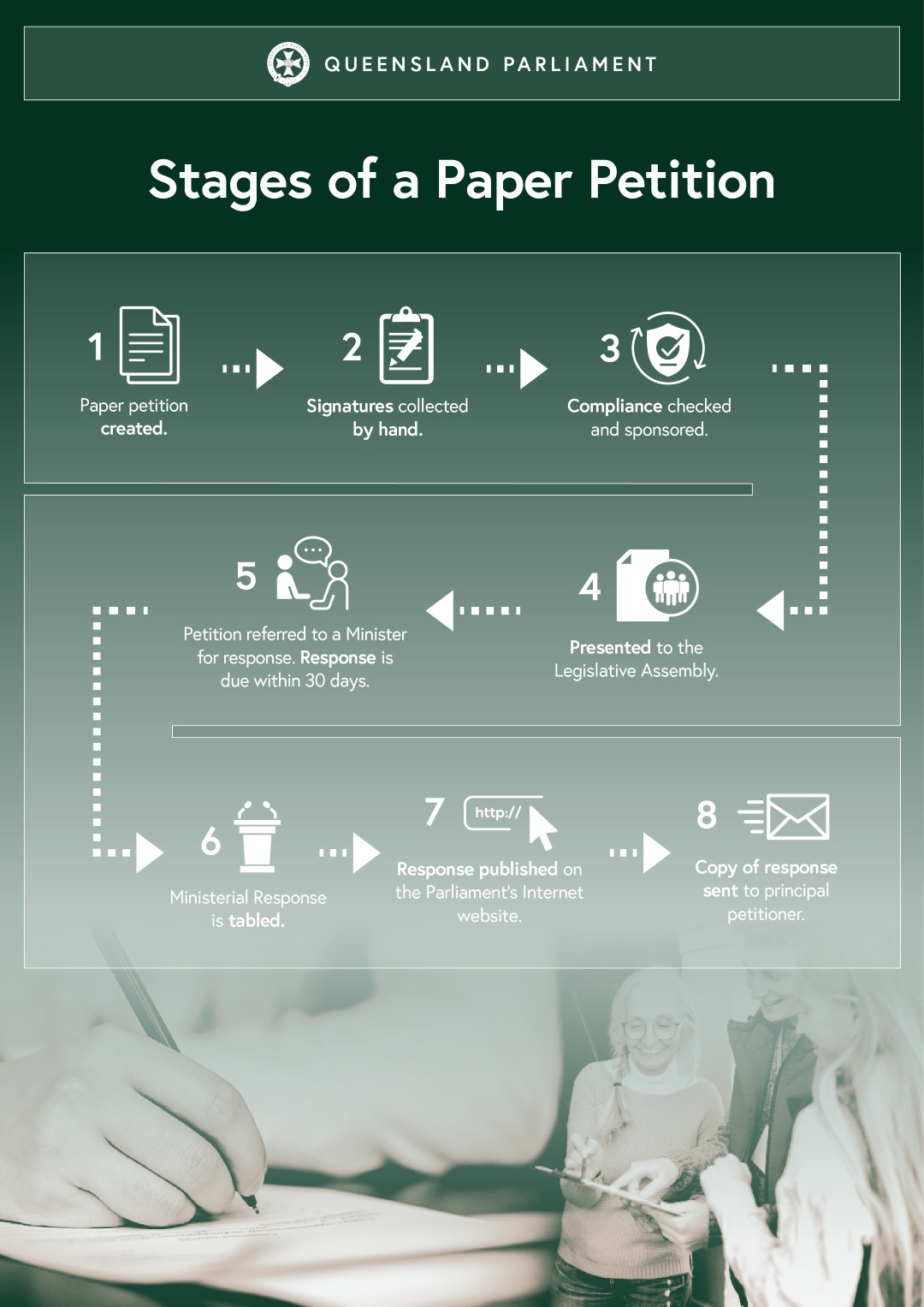
The paper petitions process is essentially the same petitions process that has been operating in Queensland for over 140 years. It involves a paper petition being circulated in the community for signatures and then lodged by a member or the Clerk of Parliament.
A paper petition must be lodged by a member of the Legislative Assembly or the Clerk. Usually, the Speaker does not lodge petitions for presentation to the House.
The member or the Clerk ensures that the petition conforms with the rules. The member or the Clerk places their signature on the top of the first page of the petition and indicates the total number of signatures contained in the petition.
If a member is lodging a petition, it must be lodged with the Clerk at least two hours prior to the sitting of the House in which the petition is to be presented.
How are E-Petitions started?
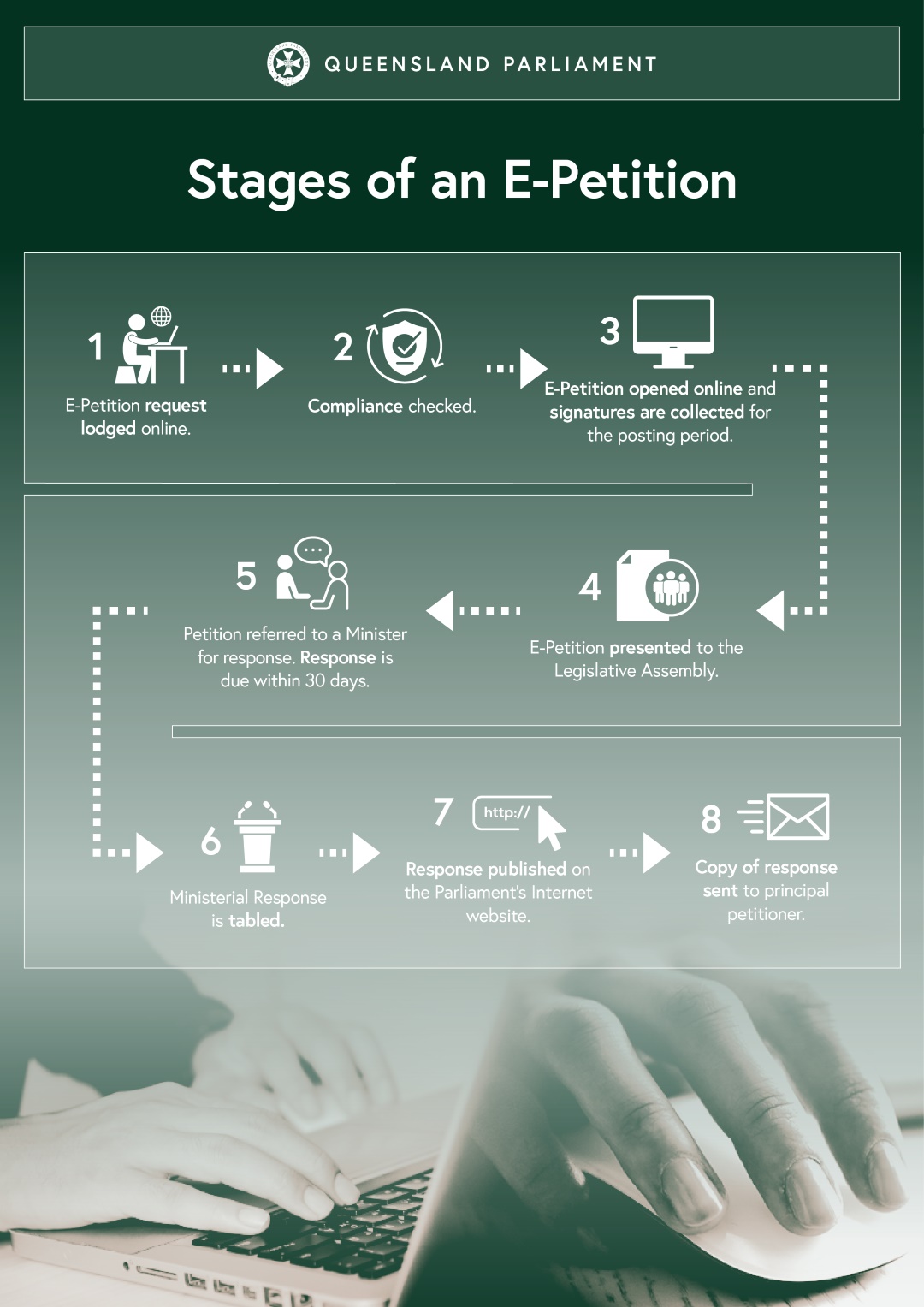
The key difference between the paper-based and electronic process for petitions relates to how the process starts. The online E-Petition form records the wording of the E-Petition; the eligibility category; how long the E-Petition will be open; the requested sponsor; and the principal petitioner’s name and address.
You can request any member to sponsor your petition, it does not need to be your local member nor does it mean the member agrees with your petition. Under current Standing Orders, there is no obligation on members to sponsor your petition. In such a case, the Clerk of the Parliament is available to sponsor your E-Petition.
The member or the Clerk may request changes to the petition wording before agreeing to sponsor the E-Petition.
Only E-Petitions hosted by the Queensland Parliament's website are deemed E-Petitions to the Legislative Assembly. Online petitions hosted on other websites are considered non-conforming petitions.
Step 2: Compliance Checking
The Clerk will check that it meets the requirements set out in the Standing Orders. If these requirements are satisfied, the E-Petition is published on the website and open for signatures until the specified closing date.
To comply with Standing Orders, the Clerk may require an amendment to the E-Petition before publishing
How long can an E-Petition be open on the website?
An E-Petition can be open for signatures on the website for a minimum period of one week and a maximum period of six months. The principal petitioner decides the closing date of the E-Petition.
Who will promote an E-Petition?
As with paper petitions, the principal petitioner is responsible for raising awareness in the community about the availability of the specific E-Petition. The principal petitioner can share the link to the E-Petition via email or on social media. The Queensland Parliament’s role is only to facilitate the E-Petitions process.
What happens after the E-Petition is closed?
Once an E-Petition has closed, the E-Petition will be made available in hard-copy format for presenting in the Legislative Assembly of Queensland. The Clerk of the Parliament will present the petition in the sponsoring member’s or the Clerk’s name on the next scheduled sitting day.
Ministerial Responses
Standing Orders provide that the Clerk of Parliament shall refer a copy of the material parts of every petition presented to and received by the House to the Minister responsible for the administration of the matter which is the subject of the petition.
The Minister shall forward a response to a petition to the Clerk within 30 days. The Clerk:
- tables the response
- forwards a copy of the response to the member of Parliament who presented the petition
- forwards a copy of the response to the principal petitioner
- ensures the response is published on the Parliament’s Internet website.
If the House is not sitting when the Clerk receives a ministerial response to a petition, the response is deemed to be tabled when it is received by the Clerk.
If a Minister cannot provide a ministerial response to a petition within 30 days, the Minister shall forward to the Clerk an interim response and the Minister’s reasons for not complying within 30 days and within three months after the petition is presented, forward to the Clerk a final response.
Frequently Asked Questions
Read some Frequently Asked Questions about petitions and their answers.
Conditions of Use
If you wish to join an E-Petition, you will need to accept the E-Petition’s Conditions of Use, which outline: the eligibility requirements; the requirement that a person may only join an E-Petition once; and the prohibition on the use of false names.
A breach of the Conditions of Use might amount to contempt of Parliament under the Parliament of Queensland Act 2001. Actions that are considered to be in contempt of Parliament include:
- presenting a forged or falsified document to the House or a committee;
- submitting a petition containing false, scandalous or groundless allegations;
- or inducing a person to sign a petition by fraud and misleading the House.
What about privacy?
Only the name and address of the principal petitioner will be made public on the website as required by the Standing Orders. The personal details of people who join E-Petitions will not be published in any form on the website. The website will only show a tally of the number of signatures collected.
Requests for copies of petitions by non-members are not provided in accordance with a policy approved by the Speaker and the Committee of the Legislative Assembly.
A Privacy Statement on the website details how your personal information will be protected.